NOVEMBER 24, 2026
Your Free Streams Just Got Worth 67% More — and You Can Finally Protect Your Name on Spotify
Two real changes landed this month, and both of them move power toward the artist. One changes what your streams are worth on the charts. The other gives you control over your own name on the biggest streaming platform in the world. Neither one is a trick. Both are worth understanding properly, because both of them reward the artists who are paying attention.
📊 Story 1: Billboard Just Made Your Free Streams Count for More
Billboard announced on Monday, November 9, 2026 that it's changing the formula on its album charts — and the change is a straight win for independent artists.
Here's the math. On the album charts, streams get converted into album units. Until now, the ratio was 1 to 2.5: it took 1,000 paid streams or 2,500 ad-supported streams to equal one album unit. From the Billboard 200 dated January 16, 2027 — tracking the week of January 1 to 7, 2027 — the ratio narrows to 1 to 1.5. That means 1,000 paid streams or 1,500 ad-supported streams will equal one album unit.
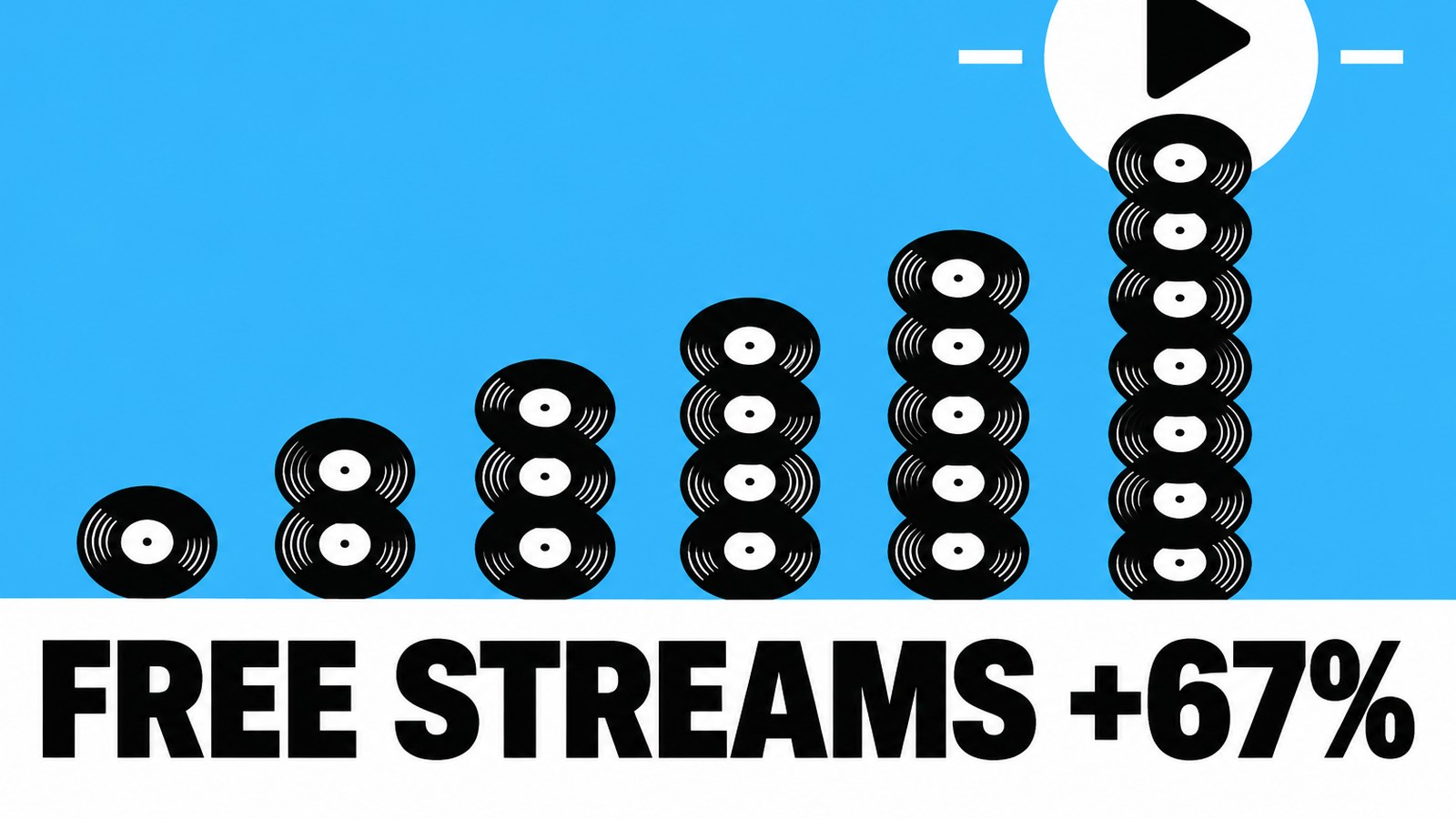
Do the division and you'll see why the headline number matters: 2,500 divided by 1,500 is 1.67. Every ad-supported stream — every free-tier listen, every fan who hears your record without a paid subscription — is now worth about 67% more toward the charts than it was before. You need 1,000 fewer free streams to earn the same unit. That's not a rounding error. That's a thousand streams per unit, back in your pocket, on every album, every week, from the day the new formula takes effect.
Why does this matter more for you than for a major-label artist? Because your audience is disproportionately on the free tier. The fans who find you on a playlist, hear you on a friend's phone, catch your song in a video — a lot of them aren't paying subscribers. Under the old formula, their listens counted for barely anything. Under the new one, they count. The same fans, the same listens, the same grind — and the chart finally weighs it closer to what it's actually worth.
And there's a second half to this story. The same day Billboard announced the change, YouTube's Global Head of Music, Lyor Cohen, confirmed that YouTube data is coming back to Billboard's US charts in 2027 — ending a withdrawal that started in January 2026 over this very formula. YouTube data has been absent from the charts since the chart dated January 31, 2026. Now it's returning, because the formula changed.
That return matters because YouTube is where a huge share of music discovery actually happens — and YouTube said it paid the music industry more than $8 billion in the year to June 2025. YouTube Music and Premium have passed 150 million subscribers, including trials. So the platform where your fans actually find you is back in the chart math, under a formula that values free listening more. For an independent artist building from the ground up, that's two tailwinds in one announcement.
Sources: Music Business Worldwide, Nov 9, 2026 (https://www.musicbusinessworldwide.com/billboard-changes-free-vs-paid-streaming-formula-on-charts-and-youtube-is-bringing-its-data-back/) and YouTube Blog, Nov 9, 2026 (https://blog.youtube/news-and-events/youtube-billboard-chart-update/).
🎵 Story 2: Spotify Will Now Warn You When Somebody Else's Song Lands on Your Name
On November 17, 2026, Spotify opened Artist Profile Protection to all artists — and if you've ever had a stranger's song show up on your profile, this is the tool you've been waiting for.
Here's how it works. You switch it on in Spotify for Artists. From then on, Spotify emails you when a release is delivered under your name. If it isn't yours, you can remove yourself from it — which keeps it off your profile, out of your stats, and out of your recommendations. You have up to 28 days after a release goes live to act.
There's also an advanced setting called "Block releases" that holds releases until you approve them — the release doesn't go live under your name until you say yes.
What is this actually protecting you from? Three things. Wrong-artist mismatches from metadata errors — the distributor tagged the wrong person, and somebody else's song landed on your page. Shared names — there's another artist with your name, and their releases keep bleeding onto your profile. And deliberate impersonation and AI fakes — somebody putting out fake songs under a real artist's name to ride their audience. Spotify spent about eight months testing this in beta with Diplo, Samia, Searows, Dave East, and The Army, The Navy. Spotify says it's the first streaming service to offer this kind of control.
Now the caveat, and it's an important one: the default mode does NOT block anything by itself. A release still goes live unless you act. The email is a warning, not a wall. If you don't check your email and don't remove yourself within those 28 days, the wrong song stays. The "Block releases" setting is the one that actually holds things back — so if your name is the kind that gets mixed up, or if you've already had a fake land on your page, that's the setting to turn on, not just the basic protection.
The move is simple: go into Spotify for Artists this week, switch on Artist Profile Protection, and decide whether you need the "Block releases" setting too. It costs you five minutes. Your name is the most valuable thing you own as an artist — it's the thing every fan searches for, every playlist credits, every royalty check is written to. Five minutes to guard it is the cheapest insurance you'll ever buy.
Sources: Hypebot, Nov 17, 2026 (https://www.hypebot.com/spotify-opens-artist-profile-protection-to-all-artists/); TechCrunch, Nov 17, 2026 (https://techcrunch.com/2026/11/17/spotifys-new-tool-aims-to-stop-deepfakes-from-being-attributed-to-real-artists/).
💰 One More Thing Worth Knowing
Duetti raised $665 million on November 17, 2026 to buy independent catalogs — $450 million in a Carlyle-anchored securitization, plus $165 million from Viola Credit and a $50 million side facility, taking its total raised past $1.3 billion since 2022. Friday's post goes deep on what catalog money means for you.
📅 Still Open — Three Chances on the Calendar
Bandcamp Friday, Friday December 4, 2026 — the last one of 2026. Bandcamp waives its revenue share from midnight to 11:59 PM Pacific. If you've got music to sell, that's the day to push it.
New Jersey Artist Grant — up to $5,000 per artist, deadline Monday November 30, 2026. You must be 18 or older and a New Jersey resident for at least one year. Funded by the New Jersey State Council on the Arts.
The Great Escape 2027 showcase applications are open, deadline February 15, 2027. If you want a stage in front of the industry next spring, the application is sitting there now.
Final Takeaway: Your free streams are about to be worth 67% more on the charts, YouTube's data is coming back to the math, and you can finally guard your own name on Spotify — but the protection only works if you switch it on and check the email. The platforms just handed independent artists two real advantages. The artists who use them this week are the ones who'll feel it first.
🎧 *Need this sound? This week's beats are live in the store → bububeats.com*
The 1,000-Fan Blueprint — free. You don't need a label to pick you: 1,000 true fans × $200 a year = $200,000. Get the math and the complete system.
Get the free Blueprint → https://stats.sender.net/forms/eVO34o/view
— BÜBU · If I can't do it, you don't need it · @bubutheproducer · bububeats.com